
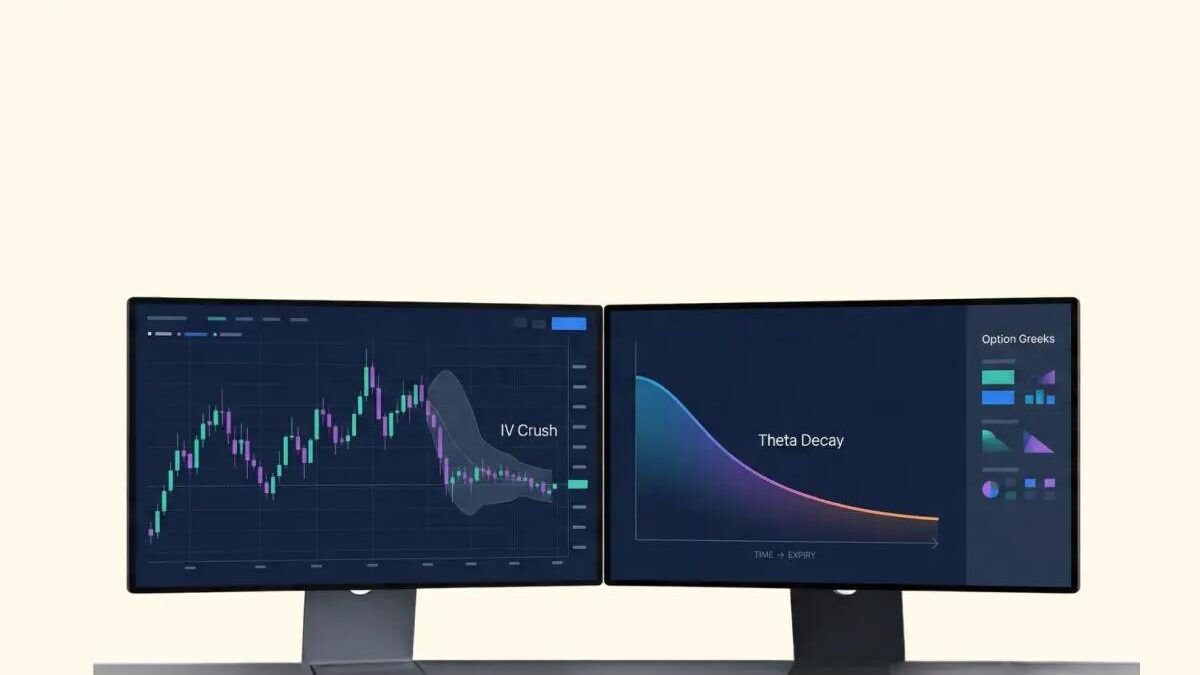

You might have noticed that the markets suddenly become too volatile on expiry days. Especially in index options like Nifty and Bank Nifty, you can observe the big changes. Sharp spikes, sudden reversals, and rapid premium decay are common sights.
Expiry day is considered a battlefield between option buyers and sellers. But why does the market move so sharply on this day? Let’s understand the real reasons behind expiry day volatility in index options.
Table of Contents
What Is Expiry Day in Index Options?
The last trading day of an options contract is known as the expiry day. In India, Nifty and Bank Nifty options have weekly expiries on every Tuesday, while monthly expiries are on the last Tuesday of every month. On this day, all open option contracts either expire worthless or settle in cash based on the index’s closing price.
Unlike stock options, index options are cash-settled. This means there is no delivery of shares — only profit or loss is credited or debited. Since the time value becomes almost zero on expiry day, option premiums react very sharply to small price movements in the index.
Key Reasons Behind Sharp Moves on Expiry Day
All expiry days face sharp moves and high volatility, including the Sensex Expiry day. Some of the key reasons behind these moves are listed below:
1. High Open Interest (OI) Concentration
Traders usually build large positions at specific prices just before expiry. These strikes create high Open Interest (OI) at specific levels. When price approaches these levels:
- Sellers try to defend their positions.
- Buyers attempt to break those levels.
- If a major OI level breaks, short covering or long unwinding starts.
If the stop losses get triggered, the market moves rapidly in one direction. Traders usually watch option chains like the BSE option chain to analyse OI concentration.
2. Gamma Effect and Aggressive Hedging
Near expiry, option Gamma increases rapidly, especially for ATM (At-The-Money) options. Due to this, when the price moves slightly, option sellers hedge their positions by buying or selling futures. This hedging increases market momentum, and small moves get amplified into big moves.
This is why expiry day usually feels like the market is moving faster than usual.
3. Time Decay (Theta) at Its Peak
On expiry day, time decay works at maximum speed. Option premiums lose value quickly, and Out-of-the-money (OTM) options can fall to zero within hours. Option buyers face rapid erosion if the price does not move immediately.
Because of this, traders adjust positions aggressively. These adjustments increase volatility, especially during the last 2–3 hours of trading.
4. Institutional Position Adjustment
A significant portion of options positions are with large institutions, prop desks, and FII. On the expiry day, they try to close their positions, roll over to the next expiry, or hedge aggressively.
Since they deal in large quantities, even small adjustments can create strong momentum in the index. This adds fuel to existing trends.
5. Break of Key Support and Resistance
Expiry day generally revolves around important technical levels. If a major support or resistance level breaks, stop-loss orders get triggered. This causes abrupt spikes or drops. More often than not, the real move starts after 1 PM when liquidity increases.
Why Index Options Show More Volatility Than Stock Options
Some of the key reasons behind the sharper move in indices like Nifty and Bank Nifty are listed below:
- Index options have higher liquidity.
- They have larger Institutional participation.
- Heavy hedging activity happens in index derivatives.
- Capital involvement is much bigger.
How Traders Can Handle Expiry Volatility
Here are some tips to help.
- Always use a strict stop-loss.
- Avoid revenge trading.
- Track Open Interest data.
- Focus on price action confirmation.
- Prefer defined-risk strategies instead of random option buying.
Final Words
For traders, expiry day is an important day as it gives many small and large moves from which traders can benefit. These moves are due to strong Open Interest concentration, gamma impact, aggressive hedging, and institutional adjustments. These factors combine to create high volatility within a short time frame.
Although expiry day carries more opportunities, trading during such a volatile market becomes very risky. Traders need to be more careful during trade and should actively manage their positions.