
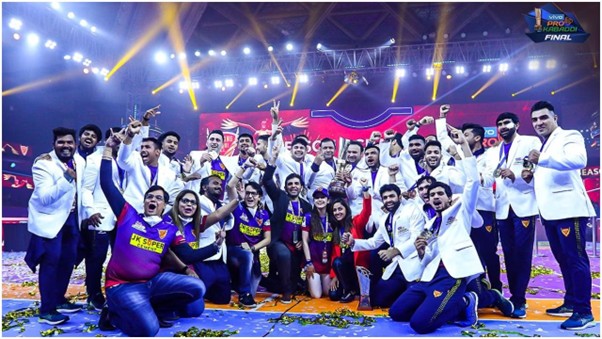
Kabaddi in India has long carried the feel of a neighbourhood contest—barefoot energy, quick thinking, and pride on the line. Over the last decade, that identity has expanded into a modern, televised product with city franchises, packed arenas, and athletes who train like full-time professionals. The Pro Kabaddi League (PKL) sits at the centre of this shift, turning a sport once seen as largely rural into a mainstream spectacle that is also helping push kabaddi onto the global stage.
Table of Contents
Kabaddi’s Professional Revolution Through the Pro Kabaddi League – Quick Answer
PKL professionalised kabaddi by turning it into a city-based, broadcast-friendly league that attracted corporate franchises, celebrity attention, and millions of viewers. The result has been higher player visibility, more structured training and tactics, and a mat-based presentation that fits modern arenas—helping kabaddi grow from a grassroots South Asian game into a sport with global ambitions, while digital engagement, including searches like parimatch login, shows how fans are increasingly connecting with the league online.
From a 4,000-Year-Old Sport to a Modern League Product
Kabaddi is believed to have originated over 4,000 years ago, and its simplicity still explains its appeal: no equipment, just strategy, stamina, teamwork, and mental resilience. For beginners, that combination is the key to understanding why kabaddi feels intense even in short bursts—every raid is a decision under pressure, and every tackle is a coordinated response.
For a long time, kabaddi carried an unfair label as a sport mainly played in rural India, with limited pull in big cities. It also struggled for broader multi-sport recognition; kabaddi was introduced at the Asian Games in 1990, and India went on to win seven consecutive gold medals in the men’s category. The dominance proved the competitive depth was real even when the spotlight was not.
PKL did not invent kabaddi’s skill or history. It changed how that history was presented, consumed, and valued.
Why PKL Changed the Conversation in India
PKL gave kabaddi a new lease of life by presenting it as a premium league product rather than only a traditional pastime. Millions of fans across the country began following the league, and that scale mattered: it created a stable audience that sponsors, broadcasters, and franchises could plan around.
Once the league concept landed, it drew film stars and corporate franchises into team and player bidding, which helped kabaddi look and feel like other major Indian leagues. The involvement of broadcasters such as Star Sports amplified reach, turning kabaddi into a prime-time television event.
Professionalisation is not only about bigger stadiums or louder crowds. It means athletes training year-round, coaches building opponent-specific plans, and a competition structure that audiences can follow season after season. It also means clearer specialisation: raiders who focus on scoring, defenders who build tackle systems, and teams that manage risk based on the score and time.
For a beginner, the easiest way to see professionalism is consistency. The more repeatable the format and presentation, the easier it is to learn the sport and stay invested.
Why the Mat-Based Format Works for TV and Arenas
PKL popularised a mat-based version of kabaddi that is easier to stage in arenas and easier to follow on screen. Clean boundaries and a consistent visual frame make raids, tackles, and all-outs clearer. That clarity supports faster storytelling: who is raiding, who is defending, what the score situation demands, and how a single mistake can flip momentum.
Broadcasting has been one of the biggest accelerators of kabaddi’s rise over the past decade. Widespread coverage, celebrity endorsements, and the emergence of local city players helped the sport travel beyond its traditional pockets. The hook, however, stayed the same: kabaddi is fast, physical, and tactical, with points that arrive in dramatic bursts.
The Live-Match Effect: What Fans Feel in a PKL Stadium
PKL’s professional revolution is not only visible on screens; it is felt in the stands. Many fans describe packed arenas, thunderous cheers, placards waving, and players warming up under bright lights as part of the league’s signature atmosphere.
Watching close to the mat changes how you read the sport. You notice the raider’s breathing rhythm, the defenders’ spacing, and the split-second decisions that decide whether a raid becomes a point or a trap. With each tackle, raid, and all-out, crowds often cannot stay seated—because kabaddi compresses tension into short sequences.
One hour can feel like a minute. That emotional pace is a major reason the league format works so well.
Key Moments Beginners Should Learn to Recognise
- Raid tempo shifts: when a raider slows down to force a defensive error.
- Defensive coordination: when multiple defenders close angles instead of chasing.
- All-out swings: when a team wipes out the opposition and flips scoreboard pressure.
- Endgame risk: when teams change strategy late, prioritising safe points or high-reward raids.
From Indian Dominance to Global Momentum
PKL’s success has helped kabaddi present itself as a sport with international potential, not just regional heritage. A major structural step came with the establishment of the International Kabaddi Federation in 2018, expanding the sport’s footprint to over 55 countries and forming five continental bodies.
International visibility has also grown through major events such as the Kabaddi World Cup. The 2025 edition in the United Kingdom showcased kabaddi’s global appeal, with India winning both the men’s and women’s categories. The broader takeaway is that kabaddi can now draw attention far from South Asia—an important step for long-term growth.
World Kabaddi Day adds a community layer to this expansion, creating a shared annual moment for fans and federations. In modern sports, these calendar anchors help build identity and keep casual audiences connected between tournaments.
New Leagues to Watch and What They Mean for PKL Fans
PKL remains India’s flagship competition, but it now sits inside a wider professional landscape. Several leagues and initiatives show how kabaddi is experimenting with formats, locations, and participation models:
- Global Kabaddi League (GKL): originally launched as the World Kabaddi League in 2024, featuring international teams such as the California Eagles and Maple Leaf Canada.
- Global Indian Pravasi Kabaddi League (GI-PKL): launched in April 2025 with 12 men’s and women’s teams, including players from Argentina, Egypt, and Germany, designed to promote gender equality and diaspora inclusion.
- Real Kabaddi League: International Edition: scheduled in Dubai, featuring teams from multiple nations.
- World Super Kabaddi League (WSKL): planned to bring together national federations to support global standardisation and recognition.
These developments highlight a key point for beginners: kabaddi is not a single uniform product worldwide. The GKL’s professional circle-style format, rooted in Punjabi tradition, offers a distinct alternative to the mat-based version popularised by PKL. Variety can be exciting, but it also creates a challenge—format standardisation—because fans and broadcasters generally prefer consistency across competitions.
How to Watch PKL as a Beginner and Still Understand the Tactics
Start with the simplest lens: each raid is a scoring attempt under pressure, and each defensive set is a coordinated plan to stop it. Then add context: the scoreline, time remaining, and which players are on the mat.
Kabaddi rewards attention to patterns—how a team sets traps, how a raider changes pace, and how substitutions affect energy late in the match. It helps to track roles rather than names at first: identify the primary raider, the secondary raider, and the defenders who initiate tackles.
A Simple Match-Reading Routine
- Before each raid, check the score gap and time; it shapes risk-taking.
- Watch the defenders’ spacing; it signals whether they want a quick tackle or a delayed trap.
- Notice the raider’s first two steps; they often reveal the intended target zone.
- After the whistle, ask why it worked: speed, angle, teamwork, or a forced error.
What Still Needs to Improve for Kabaddi’s Next Leap
Kabaddi’s momentum is undeniable, but growth brings practical hurdles. Format standardisation remains a major topic because different versions of the sport can confuse new international audiences. Consistent scheduling also matters; fans follow sports more easily when seasons and tournaments do not overlap unpredictably. Global visibility is another piece—kabaddi needs repeat exposure in multiple markets, not just one-off spikes around major events.
Even with those challenges, the direction is clear. Over the past decade, kabaddi has moved from a grassroots South Asian sport to a mainstream spectacle with global reach, and PKL has been the engine of that transformation.
In practical terms, Kabaddi’s Professional Revolution Through the Pro Kabaddi League has made kabaddi feel like a modern, career-grade sport without losing its raw, high-adrenaline identity. That balance—heritage plus professional structure—is what gives kabaddi a credible future in India and beyond.